Who Really Owns Workplace Culture? | Zach Blumenfeld & Nick Lombardino
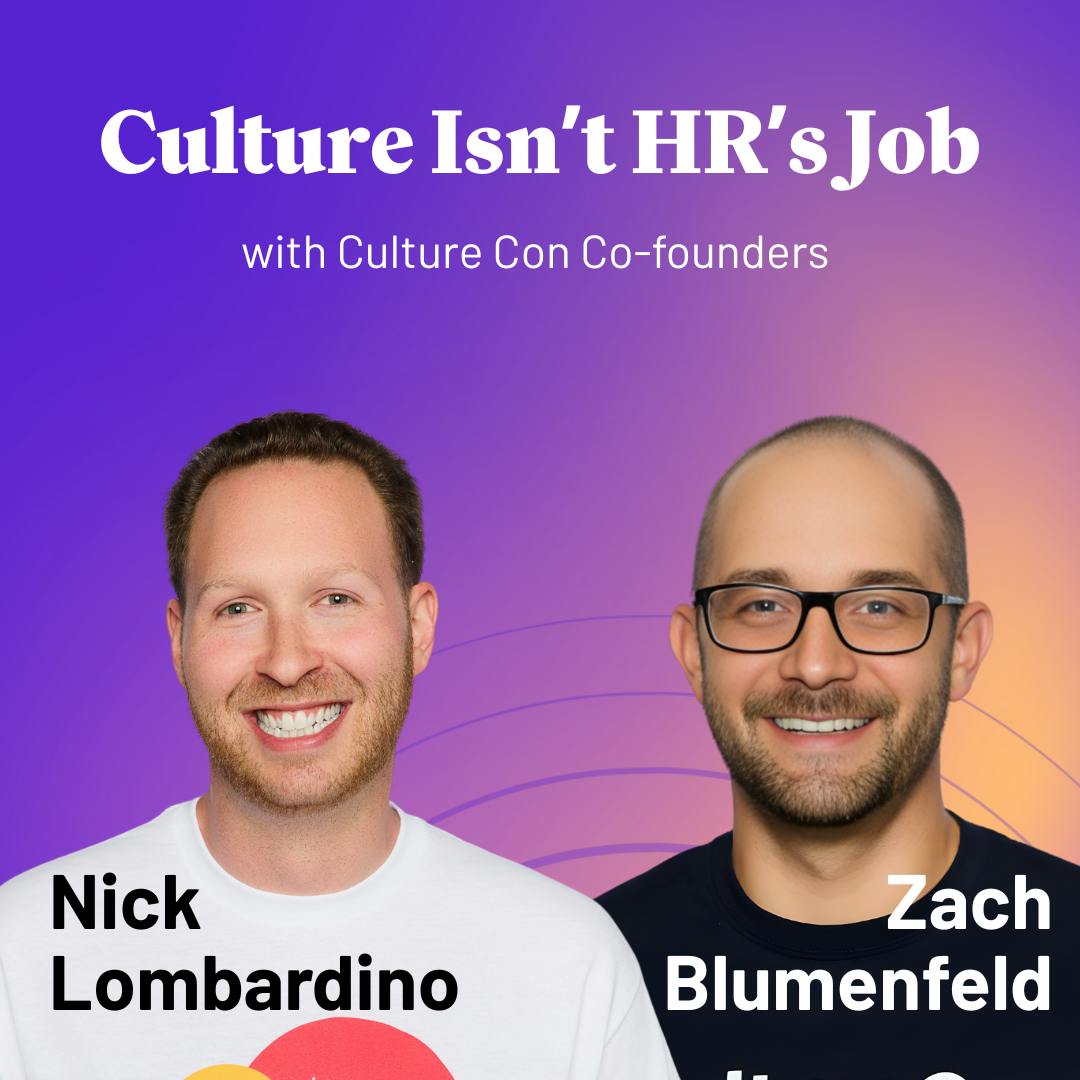


Culture Isn’t HR’s Job: Building Work That Feels Human with Nick Lombardino & Zach Blumenfeld
What if culture wasn’t something you rolled out—but something you practiced, person by person, day by day? In this episode of Human Side Up, host Natasha Nuytten sits down with Nick Lombardino and Zach Blumenfeld, co-founders of CultureCon (a certified B Corp), to unpack what actually makes workplace culture stick. From their origin story (Madison roots, high school connections, and an “accidental” community that turned into a movement) to the behind-the-scenes realities of building CultureCon, Nick and Zach share why the best cultures aren’t built by slogans—they’re built by trust, autonomy, and meaningful connection. They dig into the tension between flexibility and loneliness in remote work, why “culture fit” is often the wrong goal, and what it means to build “culture from the inside out”—starting with self-awareness, personal responsibility, and how you show up as an individual contributor. If you’re a leader trying to build culture without outsourcing it to HR—or an employee who wants to make work better from wherever you sit—this one is packed with practical insights and a whole lot of heart.
Highlights & Takeaways
💡 Culture is everyone’s job (and why HR can’t carry it alone)
💡 Trust + autonomy = real connection (not just perks)
💡 Flexibility vs. belonging: what remote work can’t replace
💡 “Inside-out culture”: self-awareness as the foundation for meaning at work
Human Side Up
Hosted by Natasha Nuytten, CEO of CLARA, Human Side Up cuts through the noise to reveal how real leaders create workplaces—and lives—where people can thrive.
Connect with Natasha:
🎧 Spotify
📺 YouTube
Connect with CLARA:
🌐 Website
📺 YouTube
Test
HSU - Zach & Nick
Natasha Nuytten: Hello, everyone. I'm Natasha Nuytten, host of Human Side Up and CEO at Clara. And I am very excited to bring you today's conversation with my friends, Nick Lombardino and Zach Blumenfeld. Nick and Zach are not only friends and buddies of the truest nature, but they are also business partners. And they are the co-founders of CultureCon, which is a certified B Corp on a mission to inspire positive change around organizational culture. They are both natives of Madison, Wisconsin. They went to high school together. In fact, their grandmothers went to high school together, which we learned today. And they are both very entrepreneurial as well. Nick is a social entrepreneur and community builder with leadership experience spanning all kinds of things, marketing, business development, operations, HR, and finance. He serves as an adjunct faculty person at Edgewood College, teaching social entrepreneurship there and small business management. Prior to making CultureCon his full-time gig, Nick also led employee experience strategies at Farwell, which is actually where he was doing the podcast from while we were talking. When he's not building communities of practice, he is an avid cribbage player, a sourdough baker, and an unabashed lunch buffet enthusiast. This will all make sense as soon as you meet Nick. Zach, on the other hand, is also super fun. Not so much a fan of the lunch buffet, but an amazing serial entrepreneur with a proven track record of launching and exiting multiple businesses across InsureTech, FinTech, SAS, HR Tech. You're seeing a theme here. And now even though he is a Madison native, he lives in Chicago. And these two are connected so deeply and are doing such amazing things. Zach's expertise lies in growth and strategy, sales innovation, workplace culture. He studied sports management, which we talk a little bit about at the University of Minnesota and has scaled several companies from startup to being established players. His personal motto, make what you do matter, reflects his commitment to improving lives through intentional workplace culture. Outside of work, Zach is a diehard Badgers fan, sports card collector. He's a huge Packers fan, world traveler, and occasionally a TV extra. You maybe might see him, no joke, on the Bear or Chicago Fire. I loved this conversation. So much fun. We talked about everything from being an individual contributor, helping to impact culture, to how leaders can show up and impact culture. And I think you're going to get as much out of this as I did. Welcome to Human Side Up today, everybody. As we could see we're in a slightly different environment and needed a little bit of sun. We've officially entered turtleneck season here in Omaha, Nebraska, where I live and also where today's guests live, which is in Wisconsin, as in Wisconsin, land of the Packers, go Pack. And I have to say this is probably going to be one of the most fun episodes that we've had here. And for all of you listening, Nick and Zach will introduce you to here in a moment. They bring the energy. They are exactly what you see here in real life, which is one of the reasons why I wanted to have them on the podcast. Usually on Human Side Up, we talk about keeping humanity at the center of leadership, right? It's messy and hard. And man, I think I already cried once this week, maybe six times. And it just can get really complicated. But it's the most important piece that keeps us doing our jobs as well as possible. And Nick and Zach are in a slightly different position. They are leaders. They work with organizations. They consult. They do a bunch of different stuff. But the reason why I wanted to have them on the podcast is because they are also the co-founders of a conference called CultureCon. And I go to a lot of conferences. I used to run a conference back in a former life. I've had nine before this one. And infusing the good juju into a conference is a really hard thing to do. And especially when it's a conference on culture, for people who really care about culture, who are leaders in their organization, trying to make work suck less for other people. And there are not a lot of conferences where I've been where it delivered on the thing that it said it was going to deliver on. And yours was one of those. So I'm excited to chat with you today a little bit about your past and how you do that and how as individual leaders and individual contributors, I know you all have a strong perspective on this. We can impact our organizations where we are. So Nick and Zach, welcome to the Human Side App Podcast. I'm very happy to have you here.
Nick Lombardino: Thrilled to be here. Thanks for having us. And yeah, when we were connecting at our conferences, just had so much fun chatting with you about your past nine lives. And thank you for all these kind words you've shared about our conference. But, Zach would certainly agree. A lot of it comes from lessons learned over the years and constantly wanting to improve and get feedback from our community. But if there is a magic of the conference, it's because of the type of person that cares about workplace culture. Their attitude and their joy and their curiosity and desire to want to be in community with other like minded individuals who, like you said, want to make work suck less or maybe a little bit more of a positive spin. It's just like, how can we make work more meaningful for ourselves and those around us? So Zach and I are just constantly telling ourselves what we did to deserve an audience in a community like this? It makes building containers a whole lot easier when the type of people that come are just so joyful and kind. So thank you.
Natasha Nuytten: Yeah, plus one, one of the things that my grandmother used to say, she was full of a lot of awesome bits of wisdom. But one was that water finds its own level. And so that comes to mind for me when especially when I think about your conference and the people that I meet and get to engage with there. To your point, there are people who care about other people and they care about making things awesome. And yeah. And so creating a container for that is fantastic. I really appreciate it. Zach, you want to add anything to that? I know you all like you more than the sum of your parts when you are together. You're very symbiotic and you often finish each other's sentences. But anything you want to add to how you all landed and what you care about the conference?
Zach Blumenfeld: Yeah, just to piggyback on Nick, like we definitely lucked out with the caliber of human that both attends the event, also speaks at the event. All of our different stakeholder groups are there because they want to make work better and life better for people. So we're very fortunate in the caliber of human that shows up at the event. And I can give a little background on how we got started because Nick and I, we actually went to high school together. We didn't know each other in high school because Nick is way older than me. Super old. No, we're just a couple of years apart. And Nick and I got introduced by one of my co-founders at a company I started over a decade ago called Third Space, which was a workplace culture software that focused on employee engagement and personal professional development. Before we had software, we would have these executive roundtables where we just kind of pressure test ideas and try to make sure we were building software to help solve different organizational culture challenges. And people would just get really passionate in these like quick hour and a half long sessions. And it was almost like therapy sessions where people would really share the good, the bad, sometimes the ugly parts of their culture. And there was this like aspect where people would chime in and be like, oh, I have that problem happening here. Here's what I did to help with that. And I need help with this. And there's just like a community aspect to it. And they would always run over an hour and a half, like someone go like four hours long. It was pretty crazy. And so I thought wow, people are getting so passionate. What if we expanded this to like workshops or maybe a smaller event? And Nick was one of the first people I pitched CultureCon to. And he said yes. And we just started building it. And it's been an amazing journey and got a best friend out of it with Nick. And yeah, later we found out we actually went to the same high school. Our grandmas went to the same high school. They're both in their 90s now. So just a lot of small world connections there, too.
Natasha Nuytten: I love that. There's so much good stuff there. Yeah, I have a few things I want to double click on. But before we do, I want to ask you both. We usually start this podcast with a question to our guests. One of you is going to have the advantage because you get to answer first or last, depending on your perspective. But the question is, what we think about as humans and the work that I try to do every day in our Clara is finding what the extra awesomeness is that each person brings to the table, right? What they bring to their role that you don't see on a resume, you don't see on a CV or in their job titles. And I'm really curious for the two of you. If there are one or two words about you and how you show up that we wouldn't see on a resume that impacts the way you are in the world, what might they be? And when did you start to know them as true and own that about who you are?
Nick Lombardino: What a thoughtful question. For me, I know creativity is there somewhere. I think creative autonomy, creative play maybe is better. Yeah, creative play. I'll give you a very recent example of when it really sunk in for me that this is a critical piece of how I can show up as my full self. Authentic self in the early days of us hosting culture con, I can't speak for Zach, but I know I had a lot of imposter syndrome when I felt like I needed to be up on stage. Being concerned that I was being thought of as an expert in certain areas where I knew I didn't have deep expertise and so I would get overly anxious and paranoid if I felt like I was up there performing as somebody that I wasn't. Yeah, imposter syndrome, I think is fair to say, and it wasn't until Zach and I stumbled upon this way for us to bring our own creative play and autonomy into our conferences, which was Natasha. If you've ever had to suffer through our ridiculous welcome videos that you have to watch.
Natasha Nuytten: Yeah, love them ridiculous.
Nick Lombardino: Oftentimes they have nothing to do with the context of the conference or culture as a whole, but for Zach and I, it just felt like 1, we have so much fun making those videos because we can be silly and dumb and not take ourselves too seriously. But then being able to show that to our audience is the 1st thing they really witness as part of the conference experience selfishly for Nick and Zach that just all of a sudden makes us feel at home and comfortable. It's if we can infuse this idea that we don't have to be performative, and we can just be silly in our genuine selves for Zach and I, it's only in service to us to feel like we can be comfortable at our own conferences. You know what I mean? We stumbled into that video as now we can't do a conference without it because we're like, we need this. This is like medicine for us. But just, yeah, that ability to bring play and creativity into your work for me personally, that's critical. If I'm not doing that, then that's where I start to feel a little bit squirrelly.
Natasha Nuytten: Awesome.
Zach Blumenfeld: Is there anything else? Oh, I was just gonna say I totally agree with Nick. That is how we roll. We have to be able to do that to be authentic. And the words that came to mind for me were authenticity and humor. With, I think, both Nick and myself what is what you get. And I feel like that is with you too, Natasha. You're so authentic. And I realized that in our first conversation. And I can talk to other people that are just like themselves. It's just, I don't know, it's better. It's more, you can have a conversation that means a lot more. Authenticity, Nick and I just show up who we are for better or worse. And that's what you get. The other one is humor. I think since I was a little kid, I don't know if I use it as a coping mechanism for pleasing people or what it is. But I love humor, both, trying to make people laugh and having fun. Into that playfulness that Nick was talking about. Yeah, I love the humor aspect of things. And if I can get on stage and get people laughing, like, all my nerves go away. Usually, they're laughing at Nick and myself, but in a playful way.
Natasha Nuytten: Usually with, right?
Nick Lombardino: Yeah, hopefully. Zach, you just reminded me of this realization I had the other day. I know I personally threw out the term bringing your authentic self to work a lot. I think historically, when I've thought about saying that, it was always through the lens of hoping that other people accepted who I was when I was coming into work or social situations and the realization I had recently was like. I never quite put enough weight on the other side of accountability. Historically, it was like. However, Nick's coming into work, I just hope that other people can be accepting of the personality that Nick's putting forward, but I never quite put enough stock into the accountability that I have to myself to get a deeper understanding of what my own intrinsic motivators are and the right types of physical environments that bring my best self forward. So that I'm actually bringing my authentic self to work and not just bringing a person that I expect other people to just accept. Does that make sense how I'm phrasing it?
Natasha Nuytten: Yeah, I think so. Zach, you probably know better than I do how that manifests for Nick. I'd love to hear from you. And I would just say, as an outsider, I think you have to, it's the notion that you can only love another person as much as you love yourself. And it's the same for me, that kind of concept. So if I'm wrong, please correct me. But I have to be able to be me in the room for you to be able to accept who I am. And one of the things that we use as a framework for talking about trust in our company, and I think I mentioned this actually at the conference, is we use the trust triangle that Frances Frye, she's out of Harvard Business School. And one of the pieces of it is authenticity. But one of the other legs, in addition to logic, is empathy. That you're also here for me. And so I think it's a combination of yes, I'm being myself, but I'm being my best self in the interest of serving what we collectively are trying to do here together. And for me, that's an example of how what you're talking about would play out. So am I dialing in on that?
Nick Lombardino: Yeah, you articulated that much better than I did. That's all Frances. And it's not to say that I felt like I've always been very blessed to work in environments where I always had deep trust that my coworkers were accepting and caring of me as a human. But it wasn't that I was bringing a disingenuous Nick to work. It was more of just oh, I have way more influence and power surrounding how my own personality shows up than I think I previously realized. And that was like the shift and just now processing the shared accountability when I think about bringing your full authentic self to work. Previously, I was always thinking of it through the lens of the coworkers, not necessarily the lens of Nick coming. You know what I mean? So that was really helpful. Natasha, thank you. It's good.
Natasha Nuytten: Yeah, very. That accountability is so important to yourself as well as to the folks around you. So let me back up the train just a little bit, because a lot of folks don't know who any of the three of us are, but they're interested in the conversation and they're going to see your smiling, happy faces in the preview. So they're going to want to hear. But I would be very curious if you wouldn't mind backing up a little bit. Zack told us a little bit about how you all met. But I'd love to hear. I'm a zigger and a zagger. I've done a thousand things before this. And I am so grateful because every single one of them prepared me for having the role and the responsibilities that I have right now. I would love to hear a little bit from each of you about what were some of those career moments for you or maybe personal moments, career moments, combinations that brought you to. Hey, you know what? We are uniquely positioned to start this thing and to start to build this community around culture and inclusion. Can you do that for me?
Zach Blumenfeld: Yeah, I like yourself. I've zigged and zagged all over a lot of different industries, which I've really enjoyed because it helps satisfy my brain and how it works and being able to do a lot of different things. I went to school for sort of in business, and then I transferred from Milwaukee to Minnesota to do sport management. Still a diehard Badger fan, Packer fan. They didn't convert me up there, but Minnesota was a great school and I got to experience working for all different types of sports teams. The Gophers did some projects with the Twins, the Timberwolves, and worked for the Madison Mallards, which is a summer baseball team in Madison where I was a marketing intern. But I also pulled pork, I painted the outfield wall, I had to tackle a streaker once, I had to dress up as a mascot and they couldn't show up. So a lot of different experiences. And I realized I like business. I like watching sports, but working in sports was a lot of work and it was pretty tough. So I decided to do something that I had no experience in. And I started selling chargers for forklift batteries. Very random. That was my first real job out of school and kind of took my sales knowledge and business and we went with it. And I had a really awesome boss, Mike Nelson, who was my first boss out of school. And that's like when I think of a leader, that's who I think of right away. And so I got to experience a really amazing culture right out of school. I worked for a couple other companies and I got to see the opposite side of that where maybe the culture isn't there. Maybe I don't have a leader that I can trust and that can mentor me. And so I got passionate about the workplace. And like I was, spending so much time at work like this needs to be a good experience and I'm not the only one who feels like this. So I teamed up with a couple of guys in Madison and we co-founded Third Space, which I talked about earlier. And that kind of led me down this culture rabbit hole that I am still in today and love in every second of it.
Natasha Nuytten: I love that. That's fantastic. How about you, Nick?
Nick Lombardino: I'm a Zag and Zigger as well. Yeah, I grew up in a family of entrepreneurs and swore that off as a possibility for me in the future. At a pretty young age, my dad owned an indoor soccer facility and managed it pretty much my entire life. And he sacrificed so much to make that business successful. And I just have deep admiration for him. But when I watched him with his struggles, I was like, that seems like way too much work. I don't want that. I don't want that stress. And so going through school, undergrad, there was a time where I was studying graphic design because I wanted to be a history teacher at a high school level. And then I finally switched to business and that's where I fell in love with. I think the path that ultimately led me to organizational culture, which was at the time marketing research and I was just so enthralled with social anthropology and consumer psychology and why do humans behave the way that they do? I started to go down a career path that was pretty heavily entrenched in marketing research until I got into a graduate level class that was on organizational ethics. And that just took me down a deeper rabbit hole into eventually workplace culture because I had this professor who became a mentor of mine. He passed away a few years ago. His name is Dr. Dennis Collins. And he was like this, he was well regarded throughout the entire country as an organizational ethicist. And he always pointed to how human behavior isn't always this black and white interpretation of what's ethically right and wrong. That sometimes it's much more complex and how it's an organization's best interest to accept the complexity and do whatever that they can to create the right framework. Frameworks and processes and systems so that people can be ethical leaders within organizations. And so that is what really got me sticky with this whole workplace culture ecosystem, if that's what we want to call it. I'm actually sitting in an office right now. It's not CultureCon's office. It was the company that I was working for full time before switching to CultureCon full time. That company's name is Farwell. They're a management consulting company in town. And I was lucky enough where they entrusted me to build the employee experience strategy for roughly a 60 person company. So not a huge one, but that's really what got me steeped in it. So that was me rolling up my sleeves and actually doing the work of building healthy workplace culture and employee experience strategies. Yeah, meeting up with Zach, the timing was perfect where I was somebody who would both be an eager consumer of the content and connections of community around workplace culture and already had a little bit of experience helping to build communities of practice around shared interest groups. At the time, it was more like change management types of communities, but it definitely felt serendipitous when we connected when we did. And then to come to find out that we went to high school together and our grandmothers went to high school together was just like it was in the stars.
Natasha Nuytten: Yeah. Yeah, I love it. I love it. So I have a few questions for you. Actually, a lot, but we'll narrow it down. When it comes to the experiences that you've had in thinking about organization, I'd be very curious to hear from each of you. And maybe your answers are very much aligned. Maybe they're slightly different. What are a couple, two or three things that you think are fundamental must haves from a leadership perspective, right? So we're not just like handing culture off to somebody, which we can talk about that whole process, but from leaders to make sure that when they're building cultures where people can thrive. And I'm thinking like outside of that, everyone needs to feel comfortable and have psychological safety. We know those things and they are super important, but I don't want you to feel like you have to always handle the big rocks. I'd actually be curious to hear from each of you, given you talk with so many different types of people and you engage around how culture is being built through the eyes and experiences that you have. Through the eyes and experiences of so many people, given your current roles, what do you think are some of the things that are like the less obvious and important pieces to the foundation to make sure that we're building places where people feel like they can show up?
Nick Lombardino: I was just talking to Zach about this not long ago, self-directed opportunities for connection. This was something that I struggled with in my work at Farwell was trying to create the right. The right systems and the right processes so that. Individuals that worked at the company didn't feel like it was reliant on the company itself to create the pathways for them to find deeper connection and community and career within the organization. Not to say that, it absolves the employer of any and all responsibilities to do those things. But that was always a big ticket item for myself and for the organization. And I don't think it's much different than how Zach and I also try to approach the culture of CultureCon and the programming that we put together. It's still our responsibility to create enough scaffolding in the container so that meaningful connections can happen. But we also don't want to be seen as the only catalyst to make those connections happen. That's part of the beauty of the conference. I don't know if you felt it, Natasha, but sometimes it feels like universal synchronicities are happening because of opportunities that you take yourself to find these deeper connections. So that's the big one that comes to mind for me is, yeah, more, more self-directed opportunities for connection.
Natasha Nuytten: I love that. How about you, Zach?
Zach Blumenfeld: Yeah, on that note, and Nick, you touched on this at the start of the episode, but having trust. And I know that's like a big word, but if we go back trust is going to create the connections that Nick is talking about. And if you have trust, I think a lot of that comes because as a leader, you're giving your team autonomy. And that autonomy is hey, I trust you to do this, whether it's culture building or something else at the organization. You feel like you're empowered. And I think a lot of people need that to create trust, which is going to create connections and then ultimately is going to create that culture that people need to thrive in.
Natasha Nuytten: Yeah, I think I really like both of those. They resonate with me in that, one of the things we talk a lot about in our company is I am responsible as the leader to create opportunities for you and to support you and to help you grow. And at the same time, you have a responsibility to own your part of the becoming and the growth and the contribution. And so what I really appreciate about what both of you said there is it is you have to establish the trust that, hey, we are here for you as an organization. I am here for you as an individual leader. And the other person has to do their part to show up and say, OK, not only am I willing to accept the gift that you're giving me of that autonomy and independence, I think you both kind of use some words similar to that. And then, but that I'm going to take that and I'm going to do something with it that then gives back and feeds back into the ecosystem. And it's hard, I think, sometimes because there's this fine line for human resource folks when you're building teams. We definitely want to hire for culture fit. Because we want people to get and have the same sort of vibe. And yet there's also it then leads us sometimes into hiring with some bias because then we only hire the people who are already doing the same things and we miss out on that extra sort of flavor in the sauce, so to speak, that somebody might bring that is a little bit different. So I'm curious if, all this stuff that you all are doing and how you talk about and consult with organizations, how do you help find the balance between culture match, like culture fit and culture add?
Zach Blumenfeld: Yeah, it's a really good point. I like how you phrase that culture fit and culture add, because I think every time hopefully your organization is continuing to grow and it might grow, expand or decrease and headcount. But every time you add someone or subtract someone, the culture is going to ship because it's always changing. And yeah, you want someone who matches your culture, but you also want someone who's going to take your culture to the next level, and it's going to happen naturally, because if you add me or you add Nick or you add yourself to an organization like we're going to slightly shift that culture, whether it's a team, a department, an entire organization. So I almost like the culture to add more than the culture fit, because that's actually what it's going to be, because it's an always evolving type of thing.
Nick Lombardino: I agree with everything you said, ZB, and I like to think of it sometimes from an innovation standpoint. If we want to use that as a business imperative, let's say, when I think about culture from an innovation standpoint, my mind goes to, oh, now we're bringing in people that don't necessarily think in a homogenous way. We're bringing in people that have different lived experiences that now produce perhaps new and novel ideas on things that we can create from a services or product standpoint or efficiency standpoint, where now we're going to be that much more competitive in the marketplace. I think everybody wants to get behind that. Yeah, we don't all want to just keep thinking the same way for the sake of keep thinking the same way. We need to be relevant. We need to be competitive. We need to be innovative. That's where I go.
Natasha Nuytten: 100%. And I think it's interesting, one of the things that I enjoyed so much about the conference, and I've been to two now for folks who are listening, there's one in Madison, Wisconsin, which of course is like the OG, you have to go there. And then there's one in Vegas, which does have a slightly different flair and a different vibe. But the core is still there. So both are amazing opportunities. I think what's interesting about it is like, when you talk about culture, sometimes, and I'm sure you experience this and even the event off the ground. But I want to take this into consideration for a long time, people will always give the ping pong table, a bad rap is that's not culture. Listen, I ran a table tennis company. I do know that culture can be built around a table tennis table. But it is not only that. And it's not the thing itself, right? It's not the autonomy itself. It's like all of the things in the stew and how people use and leverage them. But it really all does need to drive business outcomes, right? At the end of the day it's wonderful to have this culture where people feel really great, and they feel appreciated and respected. And that's amazing. And the whole, the benefit to the business, because there is, as a leader, you are responsible to your people, you are also responsible to your shareholders, or whomever is leading your company, that there is an imperative, but the impact of a positive culture on an organization and business outcomes can be exponential, right? We know retention increases, we know that people contribute to your point around innovation, that's one that really matters to me, they solve problems differently. They're able to like, they really care about the thing that they're contributing to. And so businesses are healthier on the other side. Have you seen a shift in since you started the conference, what like almost nine years ago now, right? That's pretty good. Yeah. Yeah, we've got a third grader, fourth grader. I'm curious what you've seen from shifts in leadership outside of the humans who are coming to the organization. Are they still having to make the business case for culture? Are they or are they getting it? What's the sort of zeitgeist around how culture impacts business outcomes from your perspective right now?
Nick Lombardino: It wasn't that long ago when we were doing conference programming where we felt like helping our audience create the business case for workplace culture was a critical piece of the entire conference. Zach correct me if I'm wrong. I felt like that was part of year 1 and year 2 and a lot of it came through. Organizations that were leveraging employee analytics, so right being able to actually point to data and to be able to help illustrate the business case. But then the pandemic happened, and I felt if organizational culture wasn't a business imperative for companies prior, all of a sudden, it was like, way up there at number 1 or number 2. Because not only are we talking about companies scrambling to figure out how they're going to still do business, but now stacked on top of that, we have an entire country who's stuck at home and suffering from social injustice and other existential things that are hitting our brains all at the same time. And it was like, I don't want to call it a fascinating case study, but in a very compressed amount of time, I think it became clear to just about everybody. What does it look like and feel like from a personal and professional standpoint when people are really struggling? And what does it look like when we're coming out of it? And we're feeling a little bit more in flow, let's say. So now I feel like from our conference programming standpoint, a lot of the topics we talk about at our events, a lot of the time they have to do with macroeconomic trends that are happening in the country. And so coming out of the pandemic, when there's a, at the time, there's a very significant labor shortage. This is a time now where companies are saying oh, my gosh, how do we create candidate experiences and recruiting strategies so that we can bring, attract the best talent and then retain the best talent? And now, Zach, I'd be interested to hear your thoughts. I think much of the conversation at our conferences, it's not to say that we've completely done away with helping people identify the business case. It's not to say we've completely done away with helping design important recruiting strategies and candidate experiences, but now it's almost getting more towards purpose driven cultures. Bear with me here as I fumble my way through what I think is going to be a really fun next wave of the future of work. So we talked a little bit about innovation just a moment ago. Now, what's super cool is there's a growing demand among consumers to want to give their money to organizations that they feel are putting some sort of altruistic good out into the world. And whereas in the past, we've made a lot of purchasing decisions based on cost and convenience and quality. Now, there's this 4th, 1 that's like this. Altruism thing, and it's growing fast. So now companies are seeing that and they're like, okay, what are we going to do as a business for 1 to be thought of as a company? That's putting good out into the world. And 2, maybe the way we do that is to leverage our employees in the causes and passions that are most important to them to ideate how we get there. So now, not only are we creating more economic gain for our business through new profits, through new services and ideas that our employees come up with, but simultaneously now we're creating new pathways for societal benefit and environmental benefit. So we call this social intrapreneurship is the term that Zach and I have been playing around with more and more. But that is, I would say, a future trend that both Zach and I are really excited to dive into more.
Natasha Nuytten: Yeah.
Zach Blumenfeld: And just piggybacking on that, I know a lot of the listeners are probably familiar with the B Corp movement and just watching that grow since the pandemic. I don't know how many thousands of B Corps are now, and it was just a few hundred in the US. I think that goes to show companies are getting behind this. They're putting the time to check all the boxes and make sure that their business, their DNA is around this benefit corporation, a B Corp, where you're scored on a lot of factors that aren't easy to check that box to score high on. It's environmental. It's making sure there's equality across your organization, whether that's pay or benefits or how you're hiring. It's a tough grading scale. And there's a lot of companies that are trying to get that B Corp status for a lot of the reasons Nick just touched on. And I think about, I've been in the culture world for over a decade now. And when I was first getting into selling this HR tech company that we were building, a lot of those conversations were selling the ROI on culture, which was hard to do at the time. And to your point earlier, Natasha, it was like we had an ROI calculator on how expensive turnover is. And so if you have a good culture, you keep employees, you don't have to pay that expense. But that conversation doesn't really happen anymore. I feel like people are aware of the importance of culture. And if your company isn't, they're probably not going to be in business for very much longer. It's a standard now to realize the importance of culture. But when I look at the topics, and we do a workplace culture study every year, just to figure out what topics, like crowdsourcing the topics for our conference. The most edgy topic, when we look back at CultureCon 2018, our first conference was a panel. And it was like, is remote work going to stick around? That was the edgiest topic we had. And now we're talking about psychedelics in the workplace, and many other topics that are a lot more out there. So the conversation has grown. The importance of culture has grown. And that just warms my heart that it's like something that people are passionate about all around. I talked with my 96 year old grandma at Thanksgiving a couple weeks ago, and she was talking about culture and just we didn't call it culture back then. But I know what you're talking about. So she's understanding it, which gives me a lot of hope for the world.
Natasha Nuytten: I love that. And I think, Nick, you use the word, consumers are demanding this, and that's why companies are moving toward B Corp. But, and, it's not a but, it's an and. The reality is like, when we think about some of, as a company, as leaders, our consumers are our employees, and they are also demanding the same thing, right? Yes they're voting with their dollars. And, we're seeing that a lot. And this is, in 2025, we've seen the impacts to major corporations, when they have not followed through on the commitments they said that they were going to make to particular, whether it's ESG groups, or whether it's DEI, or whatever the item is. But employees are doing the same things. And so one thing that I think we've seen a lot of is this, and I think it's becoming more and more evident to me, I feel I'm, I'll be curious to get your take on this. There's actually this on the ends of the spectrum, folks have been in the workforce for a long time, right? We've five generations now, which is the first time in history that this has happened. As people get older, they settle more into their own skin, they get to show up more authentically as themselves, they want to spend their time in particular ways and do things that matter. And so we see a shift towards the end of someone's career where value, mission, alignment, purpose become more meaningful. We see it a lot, we talk a lot about it in the news and everywhere else about younger generations that are just entering the workforce.
Natasha Nuytten: In particular, they are very lonely. They've had such a totally different experience growing up than so many people my age. I'm almost 50, right? I'm solidly right in the land of grunge growing up. There's so but there's a difference there. And what's been interesting is we hear a lot and we talked a lot about this, actually, in many of the panels that I've been to at all kinds of conferences, but definitely at the culture conference is, how do we connect people in a remote or hybrid environment to culture and help them stay connected while we're battling this sort of loneliness epidemic in our country and without getting, too crazy about the thing. I think we hear people are so resistant to coming back to offices and those types of things. But what I see and I'd love to get your take on this. I actually think that's the greasy, this loud, squeaky wheel. Yes, people want flexibility, but I think they like the idea of remote and hybrid because it offers them flexibility. And to use your word again, Zach, autonomy and being able to do things. But it's almost like throwing the baby out with the bathwater kind of thing, because younger people more and more. In fact, I just saw another article the other day. I want to say it was like I know it was at Inc. or Forbes or New York Times or something. They actually interviewed a woman here in Omaha and my neck of the woods who is now 32 who thinks about that career, right? Like she's 32. She and she came out of college, entered this world where remote was maybe a thing, and then COVID hit all these things. And she's I'm missing out on learning by osmosis and seeing someone who I don't know who's different from me handle the same kind of situation in real time that I would maybe handle in my own bedroom right alone. And so I'm interested when we think about culture and we think about the impact on business and all the things that you all are seeing. First, I'm looking for validation or putting me out on the curb . Am I wrong that the folks who really want freedom right now are like, I'm thirty five and I have three kids and I need to be able to do all the things. So they're really loud in the middle, resistant. But there is this return to. It's not going to be the same. It's going to be a new thing. What I want is flexibility and autonomy, and I want all the other stuff right. Like Jamie Dimon, JP Morgan Chase, whether or not you like what he had to say, there is something to be said for. Am I being present in this meeting? Am I paying attention? Am I learning from the other people who are around me? So you're nodding your heads. I'm hoping I'm getting a gold star on the fridge, but I'd love to hear your take on that because you're closer to so many people than
Nick Lombardino: I couldn't agree with you more. How old am I, Zach? Thirty, thirty seven, thirty eight, thirty seven. Yeah, something like that. I was shaking my head aggressively because that was one of the talks about learning more about yourself during the lockdown period. I found out very quickly that I want flexibility in my day. All right. So let me just go out and say that right away. It's fundamental to Nick feeling like he can have enough autonomy is having that flexibility and being a present father and all that really important stuff. But I found out so quickly that I burn out so fast if I do not have actual physical human connection with either my co-workers or collaborators and peers. And the screaming example of it, Natasha, was like me being on Zoom, Zoom meeting after Zoom meeting during lockdown. And I could finish a meeting and be like, I don't even remember what was talked about because I'm less patient. When I have virtual meetings, I'm less empathetic, which I hated that realization. And I'm just distracted. I'm just my brain. I'd rather be having this conversation in person some of the time. And now I'm thinking about other things that are on my to do list. But there's some physiological thing for Nick that when I'm physically with somebody where I feel so much more of an active listener and an empathetic person, and I feel like there's some other weird biochemistry that for me, at least, that relates to like quick collaboration that I can have with people in person versus if I'm working exclusively remotely, sometimes now I have to take into account like if I'm going to use Zach as an example, oh, like I have this question or this idea for Zach. Do I need to like, can I Slack message him? Does this make sense on Slack? And then maybe I'll start typing it out and be like, no, I'm not contextualizing this good. Should I text him? No, what I should do is maybe put a calendar invite out there. But wait, he's busy on Thursday, Friday, maybe Friday. And like the amount of time that Nick would spend just like lamenting over how to phrase it or struggling with logistics when there could be a mechanism for me to just be like, hey, ZB, can I bounce something off you real quick?
Natasha Nuytten: Yes.
Nick Lombardino: So there's it's hard to quantify like that type of thing that I just struggled to articulate. But for me personally I crave it. I need to have the flexibility of being able to work remotely and having heads down time and having the flexibility to do the things that I need to do and want to do. And then I also need opportunities for me to be in person with people so I can have those higher levels of human connection and empathy. I feel like Nick shows up better as a person when he's in more physical contact with people. And I don't think I'm alone. And I do think a little bit, maybe there's been a little bit of reluctance to say that this is how we're feeling for fear of if you say that you're against remote work, that maybe that's going to be misconstrued as like you don't want like equality and flexibility for those, which I don't think any of us are saying. But I think maybe that's part of some of the hesitation, just some of the hesitance on maybe trying to. So that's what I'm saying for me personally. These are the elements that get me really excited to show up.
Natasha Nuytten: Yeah.
Zach Blumenfeld: Yeah. And I think for me, it's like piggyback on everything Nick said. And there are people that are different. I think every human is different. And so having the company be able to acknowledge that and allow their team members and employees to work how they know is best for them. It goes back to autonomy and trust. But yeah, as humans, we crave connection, whether we get that from work or personal life in the same way. Like I need human connection. That's how I like to reenergize is getting energy from other people and piggybacking on that and bouncing. When I'm in person, when I get back to Madison and Nick and I are in person, it's so different than when we're virtually. We still talk pretty much every day, all day. And I feel the love and connection that way. But when we can hug it out in person or like when Nick said hey, Nick, and just like shout across the office, it's so different. And I think the challenge and the PR blowback we're seeing now with the RTO mandates is it is taking away autonomy. It might seem like it's taking away some trust if I'm requiring all my employees to be back, because a lot of people want that autonomy to have flexibility in their day if they need to go pick up a kid at three o'clock and leave early or just have things going on in the background at home, whether that's laundry or doing dishes or having to step out to the pharmacy for something like having that flexibility is huge. But yeah, it's not going to replace a virtual experience. Isn't going to replace the in-person connection that we all thrive in and need as human beings.
Natasha Nuytten: One hundred percent. This notion that oftentimes like I want to get really practical for leaders and give them some things that they can do that are not handing culture off to H.R. And I want to get really practical about some things that leaders need to be responsible for.
Zach Blumenfeld: I don't know if this is exactly the answer that we're looking for, but not handed off to H.R. Everyone owns culture and is trying to figure out how to have it's top down driven, but not have it live in H.R. and have whether that's like an ERG or a group of people from across departments come together and work on it.
Nick Lombardino: I think this one is maybe a little bit too touchy feely and maybe not practical, but in the spirit of allowing every individual to feel like they have the influence and power to show up and possibly shape workplace culture. I know for me personally, I didn't feel like my agency was as powerful as it was until after I learned more about my own personality. So going through the process of learning. And this is an uncomfortable process for many of us, because like sometimes you think, who you are in your strengths and your intrinsic motivators and your personal values. But then when you go through a more formal process of flushing that out and you start thinking about, oh, my goodness, I thought my values were maybe this, but I'm learning they're this. And what does that mean for the career path I've chosen or the relationships that I've built? So like on the surface, taking time to discover your own personality traits. It sounds easy and it sounds really fun. The reality is sometimes it can be really scary and a lot of difficult work. But on the other side of it, once like how you are, like more wired as a person, then you can start showing up to work and bringing your best self forward. And so if I'm showing up to work and I have a vested interest in wanting to show up in a way that makes work more meaningful to me, chances are I'm going to have this. I don't want to say radiance, but like this positivity that other people are going to notice and catch on to. And it's just like that contagion of positivity. And I think that's a super powerful conduit for positive workplace culture. It is like anybody and everybody should have a vested interest in wanting to show up to make work more meaningful for themselves. And oh, how cool is that when you're bringing that level of joy that permeates across the whole organization? So I don't know if that takes a ton of strategy as much as it does. Enough individual agency to go through the work to figure that out and then show up and let the rest take care of itself.
Natasha Nuytten: Yeah that's my job. Yeah, OK. I was going to say the same thing, so all right. But I don't know,
Nick Lombardino: Natasha, my ramblings, like the practicality, though, of how organizations or leaders empower their employees to take the time to learn more about that's where the rubber meets the road, I think, to the context of your question. I was just saying I didn't feel like I had. I shouldn't say I didn't feel like I didn't realize how much agency I had to positively influence workplace culture until I learned more about who I am at a deeper personal level.
Natasha Nuytten: Yeah, I think that's really important. And it's also one of the things that I appreciate about the position that the two of you have taken in that you're not just you don't just do the work that you do for HR and culture leaders. You do it to help every single person, take that ownership of how they can impact their organization. And I do think, if I may, I come from the Midwest and I grew up in the Midwest. I grew up with a daughter of a single mom who and my granny were like, you just take the bull by the horns and you don't ever appeal, you don't ever. How should I say it? Like things happen to you. OK, fine. Things happen to everybody like to deal with it. Move on. What are you going to do about it? Like you're going to let it impact everything. And so one of the things that I think about when I hear there are these demands on organizations or people is asking people to do things for them. I have to admit that I have a little bit of an action bias where I'm like, yeah, people should be kind to you and they should create these opportunities for you, but if they don't, what are you going to do about it? Are you just going to not have a great work experience or are you just going to not be a good person because something terrible happened in your life? I'm not saying that I don't have empathy for you. I'm saying like. Shit happens. I'm here with you. Let's work through it. And then how are you going to use that as the very now fertile soil for you to grow and do something different? And I think a lot of times when I think about workplace culture, that comes to mind for me, right? Like people can do a lot for you, but you have to figure out how you fit into that equation and where you're bringing, bringing in the juice, and adding to the mix of things.
Zach Blumenfeld: 100 percent. And yeah, like what you're talking about, what Nick's talking about, we like to call it culture from the inside out, figure your own shit out.
Natasha Nuytten: Yes. Yes.
Zach Blumenfeld: What's going to motivate me? What lights me up at work? What are my core values as a person? And I think if we're all sitting around a conference room table, we all figure out our own internal values that's going to align or help decide what our values are as an organization, because if someone else decides what the values are and all three of us are like those don't align with me, we're out of there. Like we're not going to work for that organization. So it's got to almost be like co-created. But that starts with the individual figuring it out for themselves.
Natasha Nuytten: Totally. Totally. I have I could talk with you all day, but I know we have things that we need to go do. So before we go, I have one final sort of parting question for each of you. Actually, two. One is there anything I haven't asked you today that I should have? And if so, what is that? What do you want to leave us with?
Nick Lombardino: Who, what band or musician are we all particularly into right now?
Natasha Nuytten: Oh, I am right now. Right now.
Nick Lombardino: Yeah. Today. And it doesn't have to be a new artist.
Natasha Nuytten: Yeah, no, I'm trying to decide if I need to be the first person to answer. I've got to.
Nick Lombardino: OK, you go.
Natasha Nuytten: I love McCoy Tyner. He is a jazz pianist deeply into that. I'm loving that right now. And on the flip side of that, if you could take me to three days of Dead and Company shows, I'm going to be your best friend. So I'm oscillating between those two things right now. How about you all?
Zach Blumenfeld: I have an interesting taste in music. My playlist is pretty consistent. It's like half Adele and half J. Cole. So that's my jam. OK, I'm into it. That's good.
Natasha Nuytten: Yeah. I also have to.
Nick Lombardino: I also have two submissions. One is a band named Lawrence. It's a brother and sister from the East Coast. They sing something that's like a fusion of soul music with kind of modern pop undertones. But they have a huge brass band. And so if you like the horns and trumpets, saxophone, like it's incredible. So I'm really big into Lawrence. We just went to see them in concert in Milwaukee not that long ago. And then the other person I'm trying to get more into, and I'm embarrassed that I haven't gone as far as a lot of other people, is Jean-Baptiste. If you're familiar with him. OK. There was a question on the Internet, which was if you were responsible for introducing aliens that are invading Earth and it's imminent and it's your responsibility to introduce the aliens to one person on Earth that you think might change their mind on a hostile takeover. The number one submission that the community came up with was Jean-Baptiste. And then everybody was just giving evidence. And this guy is one of the most talk about just like a guy who lives in the moment and is just constantly in awe of everyone's beauty and talents. And meanwhile, he's like a genius. And it's just like on another planet. No pun intended just like musical composition. So that's the guy I want to get more into now. So he's going to save. I love it. Save humanity.
Natasha Nuytten: He's here for all of us. It's awesome. And on that note for the people. Awesome. All right. How can we as a community be supportive of you as individuals and collectively of the work that you are doing together?
Zach Blumenfeld: Thank you for asking. We just like to be connected to as many awesome humans as possible. Yeah, I would just encourage people to join our community, whether that's virtually in person and just keep doing the good work out there that we're all trying to do.
Nick Lombardino: Yeah, I agree with that. There are great ways to dip your toe into our community. We have a ton of free programming and resources. And then if things feel fun and exciting in the future, we'd love to see you in person sometime at one of our events. Yeah. Thank you, Natasha.
Natasha Nuytten: Yeah, right on. Thank you both for joining me. I know you have plenty of other things to do, but I really appreciate it. And we'll continue to be banging the culture con drum out in the world. So thank you. And thank you all for joining us. And keep the human side up.
Nick Lombardino: Thanks, Natasha.
Natasha Nuytten: All right. Thank you. OK, that's it. Another episode. And man, what a great time. I really appreciated what they had to say about not only being an individual contributor to culture, but owning your part in knowing who you are and how you show up. Whether you are an individual working in an organization or a leader. Really great stuff. I encourage you to check out what Nick and Zach are doing with Culture Con. Maybe check out the conference itself. I might see you there. And in the meantime, keep the Human Side Up.


